

2026 Hyundai Santa Fe vs 2026 Jeep Grand Cherokee: Why Santa Fe Is the Better Family SUV in Ontario
2026 Hyundai Santa Fe vs 2026 Jeep Grand Cherokee: Why Santa Fe Is the Better Family SUV in Ontario
Posted on July 17, 2026
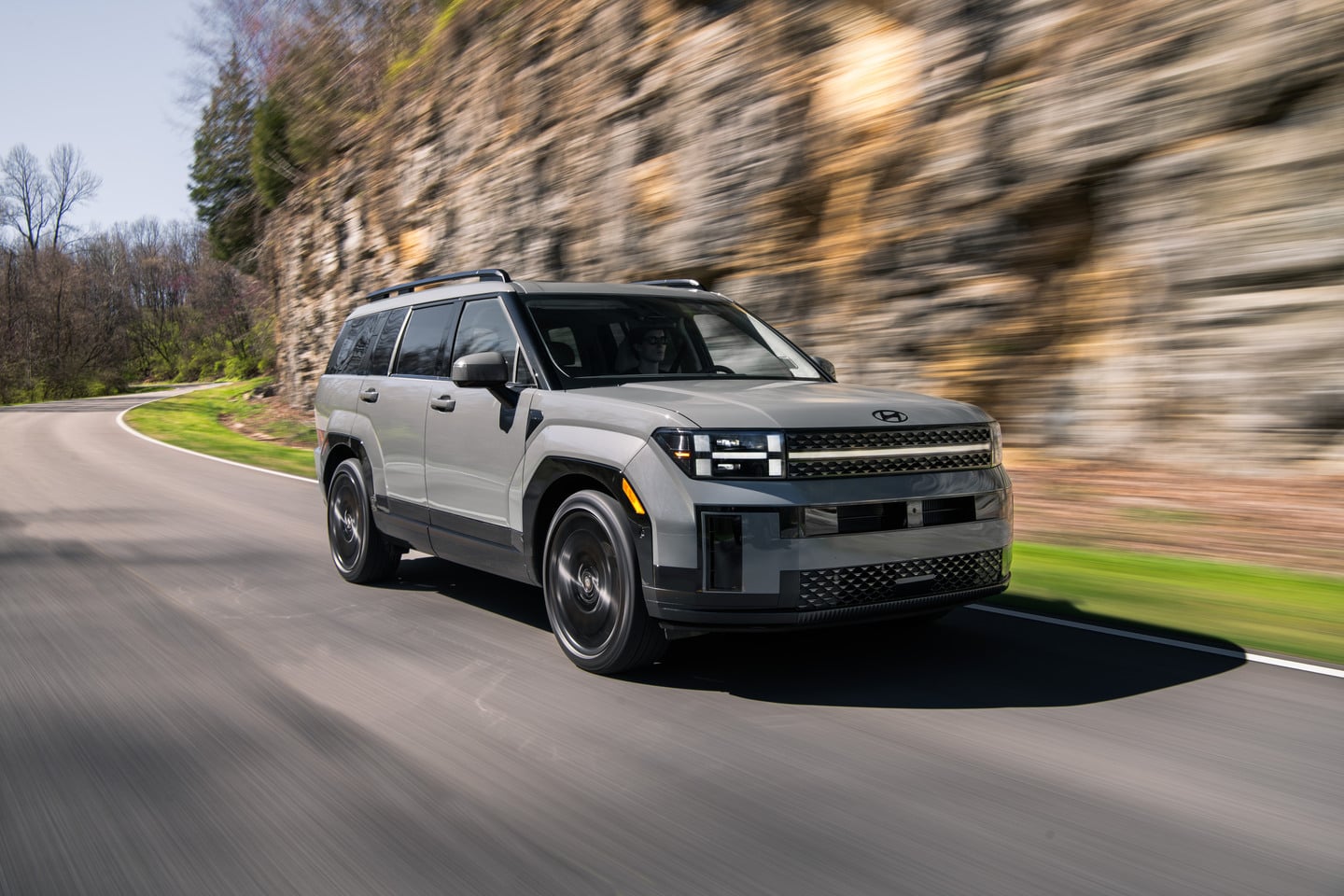
Choosing a family SUV in Ontario often comes down to two shapes: a family-first three-row crossover, or a traditional off-road-styled SUV built for a different job. The 2026 Hyundai Santa Fe and 2026 Jeep Grand Cherokee sit on opposite sides of that line.
For families juggling car seats, ski gear, and weekday routines, that difference shows up in the cabin, the fuel bill, and how many people fit in the back seat.
2026 Santa Fe vs. Grand Cherokee: Key Specs Compared
| Category | Santa Fe | Grand Cherokee |
| Combined Fuel Economy | 6.9 L/100km | 10.4 L/100km (Limited Reserve) |
| Seating Capacity | 7 (6-passenger available) | 5 |
| Max Cargo Volume | 2,267 L | 2,004.8 L |
| Basic Warranty | 5 years / 100,000 km | 3 years / 60,000 km (Limited Reserve) |
| Horsepower | 231 hp | 324 hp (Limited Reserve) |
| Torque | 271 lb-ft | 332 lb-ft (Limited Reserve) |
| Max Towing | 2,000 lbs (907 kg) | 6,200 lbs (2,812 kg) |
| Ground Clearance | 177 mm | 261.6 mm (Limited Reserve) |
Seating and Cargo for Family Life
Every 2026 Santa Fe trim seats seven, with the Ultimate Calligraphy trading the third bench for six-passenger captain’s chairs in the second row. The standard 2026 Grand Cherokee seats five; a longer Grand Cherokee L offers a third row as a separate model.
A three-row layout changes what a Tuesday looks like: carpool one week, a friend’s hockey bag the next, groceries and a stroller the week after. The Santa Fe’s cargo space adjusts with it, from 413 L behind the third row to 2,267 L with both rear rows folded.
The Grand Cherokee’s cargo hold peaks at 2,004.8 L with its rear seats folded, and 1,067.5 L behind them upright. That works for two adults and gear, but it does not scale to a third row of passengers the way the Santa Fe does.
Powertrain and Everyday Fuel Costs
The Santa Fe runs a 1.6-litre turbocharged four-cylinder hybrid system producing 231 hp and 271 lb-ft of torque through a 6-speed automatic and standard HTRAC all-wheel drive. Combined fuel economy lands at 6.9 L/100km.
The Grand Cherokee’s 2.0-litre turbocharged four-cylinder makes more power in Limited Reserve and Altitude trims, at 324 hp and 332 lb-ft. That extra output comes with a combined rating of 10.4 L/100km, notably thirstier than the Santa Fe hybrid over the same distance.
For a family doing school runs, errands, and weekend trips, that gap adds up in fuel spending over a year of Ontario driving, without asking the driver to give up all-wheel drive or a turbocharged engine.
Technology and Everyday Comfort
Every 2026 Santa Fe trim includes a 12.3-inch display, either the standard ccNC lite unit on Preferred and Trend, or the navigation-equipped ccNC on Luxury and Ultimate Calligraphy. Heated front seats and a heated steering wheel are standard across the lineup, with ventilated front seats and heated second-row seats added on Luxury and Ultimate Calligraphy.
The Grand Cherokee Altitude trim also includes a standard 12.3-inch infotainment system, so screen size is not a separating factor here. The Grand Cherokee Summit’s available 19-speaker McIntosh audio system tops the Santa Fe’s 12-speaker Bose setup, but that flagship trim also carries the heaviest curb weight in the Grand Cherokee lineup, at 2,170 kg, and a ground clearance jump to 320 mm, changes aimed at trail use rather than daily errands.
The Santa Fe’s compact footprint and standard 7-passenger seating serve most Ontario families more directly, and its Ultimate Calligraphy trim pairs the Bose system with a 12-inch head-up display and dual wireless charging pads, features that reach a mid-range three-row SUV instead of sitting only on a specialty trim.
Traction, Towing, and Weekend Capability
Both the Santa Fe and Grand Cherokee send power to all four wheels, HTRAC on the Santa Fe and four-wheel drive on the Grand Cherokee. The Santa Fe adds Snow, Mud, and Sand drive modes standard across every trim, useful for a gravel cottage road or a snowy driveway.
The Grand Cherokee’s Selec-Terrain 4x4 system, standard from Altitude up, and the Summit’s Quadra-Trac II system with air suspension push ground clearance to 320 mm, built for trail driving beyond what most family SUVs see.
Towing tells a similar story: the Grand Cherokee’s 6,200 lbs (2,812 kg) rating outpaces the Santa Fe’s 2,000 lbs (907 kg). That gap matters for a family hauling a large travel trailer, but a Santa Fe owner adding a small camper or utility trailer for weekend trips still has real capacity to work with, alongside better fuel economy for the drive there and back.
Why the Santa Fe Fits Ontario Families
For most Ontario families, the everyday case leans Santa Fe. Three-row seating comes standard, not as an upsell, and the hybrid powertrain trims fuel costs without giving up all-wheel drive or turbocharged power.
The ownership picture backs it up. The Santa Fe carries a 5-year/100,000 km basic and powertrain warranty, longer than the Grand Cherokee’s 3-year/60,000 km basic coverage, plus an 8-year/160,000 km warranty on the hybrid battery.
The Grand Cherokee’s higher towing capacity and extra horsepower reflect a different design goal, built around heavier trailers and trail driving. Most Ontario families use their SUV for school runs, errands, and weekend trips rather than heavy-duty towing, and the Santa Fe’s cabin flexibility, fuel economy, and warranty coverage make it the clear pick for that routine.
Book a Look at the 2026 Santa Fe
The 2026 Santa Fe brings standard three-row seating, a fuel-efficient hybrid powertrain, and a warranty built for long-term ownership to the mid-size SUV segment, addressing the daily needs of Ontario families without asking them to compromise on capability.
Visit 401 Dixie Hyundai in Mississauga to sit in the Santa Fe’s cabin, compare its seating configurations in person, and see its technology and warranty coverage up close. Book a test drive to see how it fits your routine.